Set up Microsoft Azure Blob storage
Connect your Microsoft Azure Blob storage container with Label Studio. For details about how Label Studio secures access to cloud storage, see Secure access to cloud storage.
Set up CORS for Azure blob storage
If you are planning to use proxy storage, you can skip this step.
If you are planning to use pre-signed URLs, you must configure CORS.
For more information, see Pre-signed URLs vs. Storage proxies.
In the Azure portal, navigate to the page for the storage account.
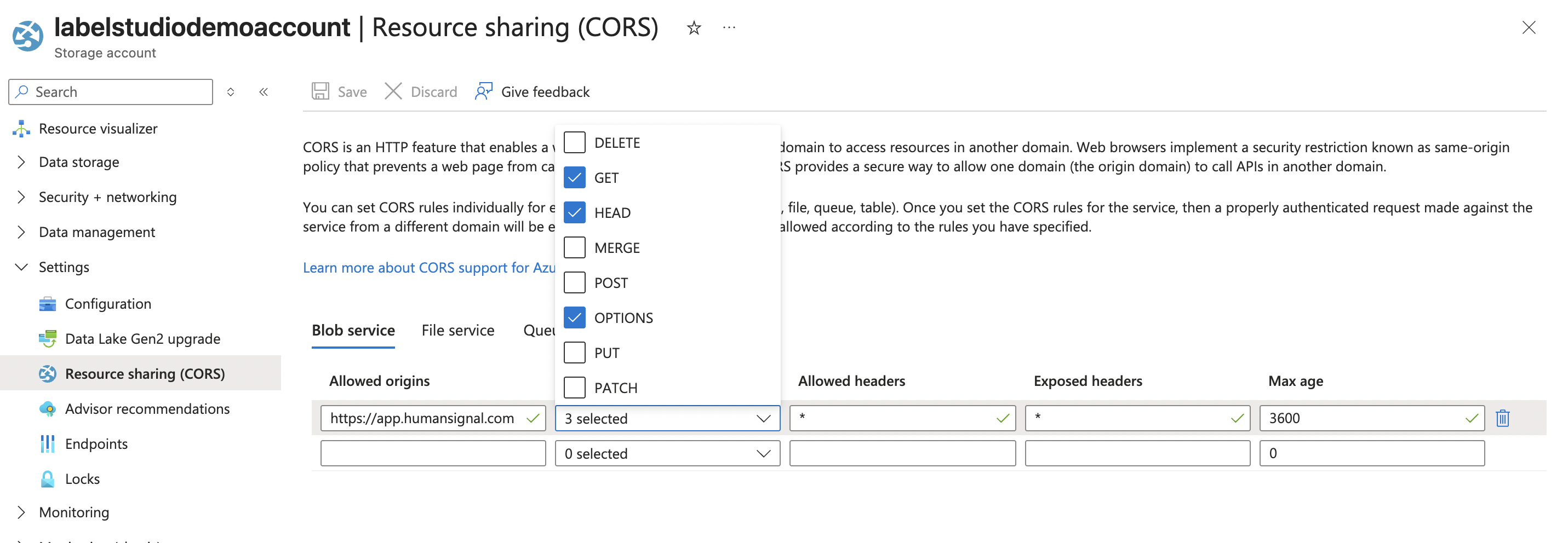
From the menu on the left, scroll down to Settings > Resource sharing (CORS).
Under Blob service add the following rule:
- Allowed origins:
https://app.humansignal.com(or the domain you are using) - Allowed methods:
GET, HEAD, OPTIONS - Allowed headers:
* - Exposed headers:
* - Max age:
3600
- Allowed origins:
Click Save.
Azure blob storage
Before you begin, review the information in Cloud storage for projects and Secure access to cloud storage.
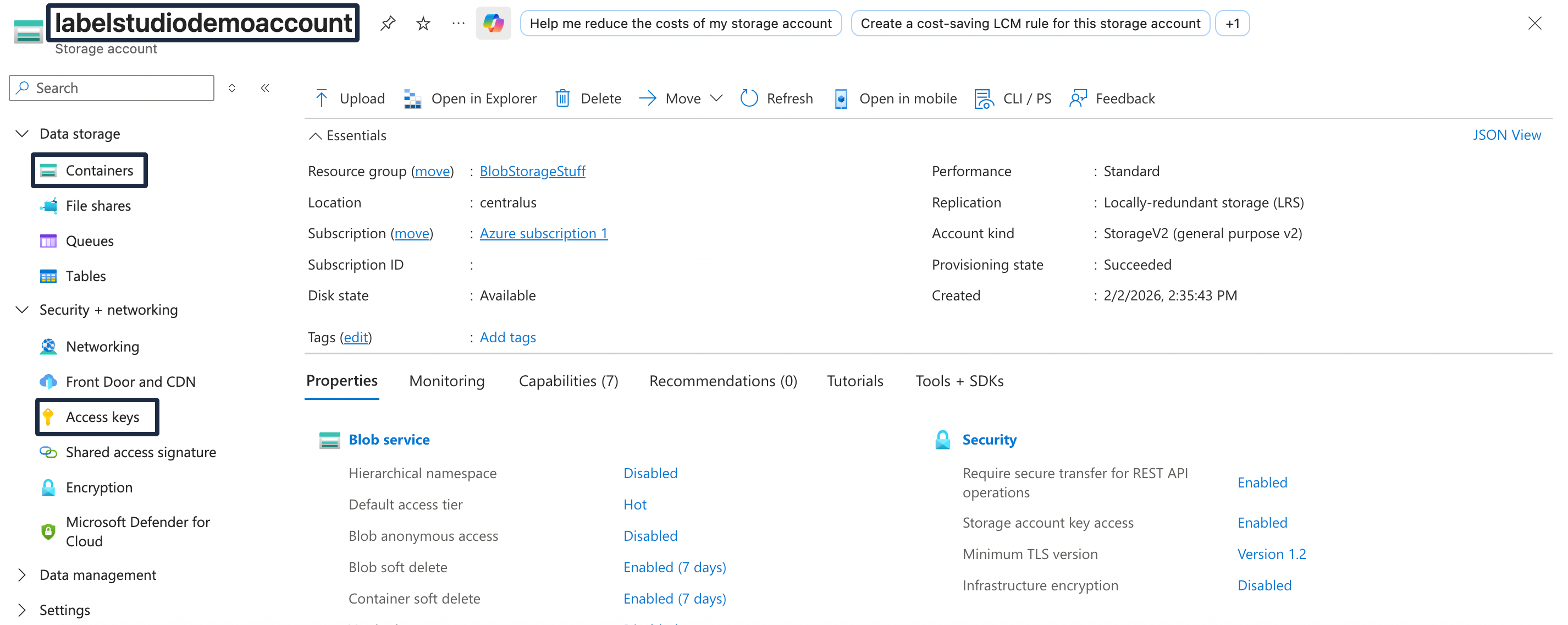
You will also need to provide the following information. It can all be found on the resource page for your storage account in the Azure console.
You will need:
- The name of the container you are using
- The name of your storage account
- The access key associated with your storage account
Tip
If you are working in an on-prem deployment, you can set the AZURE_BLOB_ACCOUNT_NAME and AZURE_BLOB_ACCOUNT_KEY environment variables instead of manually adding them into the UI.
Create a source storage connection
From Label Studio, open your project and select Settings > Cloud Storage > Add Source Storage.
Select Azure Blob Storage and click Next.
Configure Connection
Complete the following fields and then click Test connection:
| Field | Description |
|---|---|
| Storage Title | Enter a name to identify the storage connection. |
| Container Name | Enter the name of your Azure storage container. This can be found in the Azure console on your storage account resource page under Data storage > Containers. (See the screenshot above.) |
| Account Name | Enter the name of your Azure storage account. (See the screenshot above.) |
| Account Key | Enter the access key for your Azure storage account This can be found in the Azure console on your storage account resource page under Security + networking > Access keys. (See the screenshot above.) |
| Use pre-signed URLs (On) / Proxy through the platform (Off) |
This determines how data from your container is loaded:
For more information, see Pre-signed URLs vs Storage proxies. |
| Expire pre-signed URLs (minutes) | Control how long pre-signed URLs remain valid. |
Import Settings & Preview
Complete the following fields and then click Load preview to ensure you are syncing the correct data:
| Bucket Prefix | Optionally, enter the directory name within your container that you would like to use. For example, data-set-1 or data-set-1/subfolder-2. |
| Import Method | Select whether you want create a task for each file in your container or whether you would like to use a JSON/JSONL/Parquet file to define the data for each task. |
| File Name Filter | Specify a regular expression to filter container objects. Use .* to collect all objects. |
| Scan all sub-folders | Enable this option to perform a recursive scan across subfolders within your container. |
Review & Confirm
If everything looks correct, click Save & Sync to sync immediately, or click Save to save your settings and sync later.
Tip
You can also use the API to sync import storage.
Create a target storage connection
From Label Studio, open your project and select Settings > Cloud Storage > Add Target Storage.
Select Azure Blob Storage and click Next.
Complete the following fields:
| Storage Title | Enter a name to identify the storage connection. |
| Container Name | Enter the name of your Azure storage container. This can be found in the Azure console on your storage account resource page under Data storage > Containers. (See the screenshot above.) |
| Container Prefix |
Optionally, enter the directory name within your container that you would like to use. For example, data-set-1 or data-set-1/subfolder-2.
|
| Account Name | Enter the name of your Azure storage account. (See the screenshot above.) |
| Account Key | Enter the access key for your Azure storage account This can be found in the Azure console on your storage account resource page under Security + networking > Access keys. (See the screenshot above.) |
| Can delete objects from storage | Enable this option if you want to delete annotations stored in the container when they are deleted in Label Studio. |
After adding the storage, click Sync.
Tip
You can also use the API to sync export storage.
Azure blob storage with Service Principal
In Label Studio Enterprise, you can use Azure Service Principal authentication to securely connect Label Studio to Azure Blob Storage without using storage account access keys.
For more information, see Azure Blob Storage with Service Principal in our Enterprise documentation.
Add storage with the Label Studio API
You can also use the API to programmatically create connections. See our API documentation.